Skip to Content Skip to Search Go to Top Navigation Go to Side Menu


The Nile Route, Days 8 and 9


Tuesday, July 1, 2008

Sudan doesn’t have much to offer the casual traveler, but the most famous destination in the country, the Meroe pyramids between Khartoum and Atbara, was my reason for taking the long way around on my journey north.

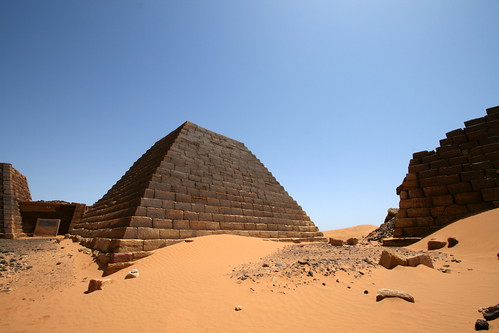
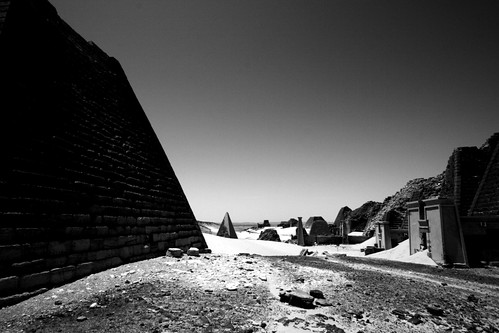
The pyramids are located off the road on which I had just traveled from Khartoum near a tiny village called Bejarawiya. There is no accommodation nearby (besides a $100/night Italian-owned “luxury camp”), so my plan was to make a day trip using the public buses. From Atbara, I rode to ad-Damer, then got on another bus bound for Shendi. About 2 hours into the ride, I spotted the pyramids in the distance and asked the driver to stop. I stepped out into what felt like the absolute middle of nowhere.

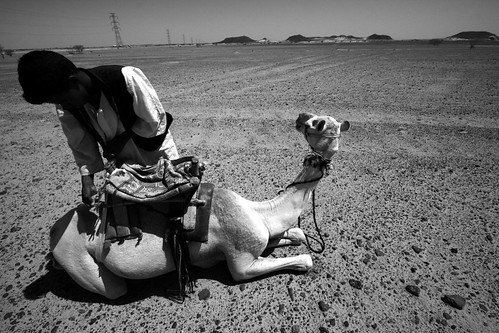
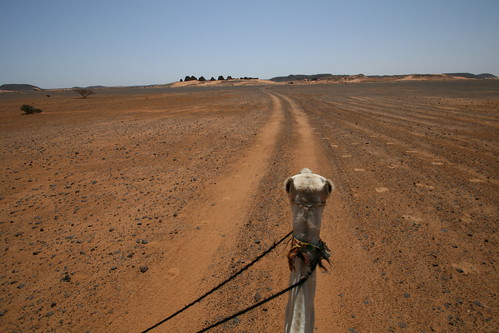
The bus drove off and soon I was completely alone. Not wanting to waste any time, I started walking towards the pyramids, a dozen of which were clearly visible atop a large dune about 1/2km away. For a few minutes the only thing I could hear was the sound of my footsteps. As I approached the pyramids, a young boy on a camel emerged from the shimmering horizon, riding towards me. He rode up to offer me his camel for the remaining few hundred meters - I gladly accepted, the mid-day sun was in full effect and I was already tired - and gave him 3SP. He showed me the way to the khaffir, who sold me an entry pass for 20SP.

I spent about 2 hours walking around amongst the 50 or so small pyramids and met not even one other tourist. Although they are miniatures compared to the sheer scale of the pyramids at Giza and Dashur in Egypt, they are just as impressive for their complete isolation. No touts, tour buses, or freelance guides, just the sun and the silence.

I took frequent breaks to rest inside the open pyramids - the only refuge from the intense heat of the direct sun. At one point, I sat down in one of the tombs to study the Egyptian-styled carvings that covered the walls and accidentally fell asleep. It was a bird, returning to its nest in the roof of the tomb, which finally woke me up an hour later. I was soaked in sweat. I had a confusing, surreal experience waking up alone in an ancient pyramid in the middle of the desert…

When I’d had enough sun and sand, I walked back out to the road where the bus had dropped me off. I checked the time: 12:24pm. The sun was beating down - I was a little worried about possibly having to stand by the road for more than an hour with my arm out. I had been told that hitching in Sudan was easy, but I was surprised at just how easy it turned out to be: at 12:25 I was riding high in the cab of a huge truck bound for Atbara with two smiling Sudanese guys.

We stopped at ad-Damer for a break and a tire change. They told me it would be a 30 minute wait, so I went into a small shop to buy cold drinks for everyone (I tried repeatedly to offer money for the ride, it was refused). A policeman in the shop asked me what I was doing, who I was traveling with, and where I was going. When I told him that I needed to get back to Atabara, he said “come with me,” stepped out into the road, flagged down a huge fancy luxury bus from Khartoum, and told the driver that I must ride free to Atbara.

I was back to my cheap dirty lokanda so much sooner than I had expected, I didn’t know what to do with myself for the rest of the day!

The New Site


Sunday, April 20, 2008

You may have noticed, I’ve finally overhauled the FFF site. I took advantage of an extra day in Dongola, Sudan, and made use of the great internet connection here to upload photos, type out entries and pour some love into this neglected blog.

I’ve chronicled the first few days of my current adventure: traveling the length of the Nile from its source in Ethiopia to its end in Egypt.

Comments are back again! Please leave some!

The Nile Route, Days 6 and 7


Sunday, April 20, 2008

I spent 3 days in Khartoum, sleeping on the dusty roof of the Bahara G’zar lokanda with about 40 older Sudanese guys. They paid me little attention but I was told that I was the first khawaja to have ever stayed there. Truly an honor.

I managed to complete the registration process at the Aliens Registration Office. I had to fill out another form, pay a total of 87SD ($43), give 2 more passport photos and photocopies, and have the owner of the lokanda write a letter to “endorse” my visit. The amount of paperwork was staggering.

I also made a couple trips to the Ministry of Tourism - a hard to find building with no English signage - in order to obtain the requisite “Photography Permit” for my camera. Another form, two more passport photos. A note at the bottom of the permit explains the rules:

Military areas, bridges, train stations, broadcasting and public utilities such as water, gas, petrol and electricity works are not be filmed. Slum areas, beggars and other defaming subject are not to be photographed [...] Applicant should inform governmental authorities i.e. local government inspector, town clerk, executive officer of general authority before actually start filming.

I made a visit to the fantastic Omdurman souq and explored Khartoum a bit before I headed off to Atbara.

The Nile Route, Day 5


Sunday, April 20, 2008

Eight hours later, at 2am, I arrived in Khartoum, tired and disoriented from the full day of bus travel. I asked the first taxi driver I saw to take me to souq as-Shabi.

“OK! Ten Pounds!”

M’rees (my friend from the station in Gedaref) smacked him on the head and then told me that we’re already at as-Shabi. Realizing that in my current state I probably would’t do too well on my own, M’rees got into a taxi with me and tried to locate a hotel. He was starting to get frustrated - we could only find expensive ones - so he took me to his aunt’s place and offered me a spare bed for the night! I was in no position to turn him down, so I very gratefully accepted. M’rees woke me at 8am to serve me tea and biscuits. The tradition of hospitality among the Sudanese is something I’ve heard stories about from everyone I’ve met who’s traveled here, and already I’m experiencing it myself. M’rees’ brother drives a tuk-tuk, so he took us downtown for a 2nd try at finding a hotel.

We visited two places near as-Shabi but they told me that I’ll have to check in with the police before I can get a bed anywhere. So, to the police station… They seemed confused by this “checking in” business I was asking about and sent me across town to the US embassy. M’rees and I went there, only to be met with more confusion. The guard told me that all foreigners should stay at the Hilton. Right! He directed me to the Aliens Registration Office which is, thankfully, right around the corner from the embassy. However, being Friday, the office was closed until the next day.

“Welcome to Sudan!” the guard told me when I threw up my arms in exasperation. “Don’t worry! Come tomorrow.”

M’rees took me back to as-Shabi and after asking around at quite a few lokandas we managed to find one that gave me a bed for 7SD a night. It was far from luxurious - in fact one of the worst places I’ve ever slept - but I wanted to let M’rees go and the price was certainly right. I was given a mattress with a sheet and a pillow. “It is heat - you sleep roof, up up,” the man at the desk told me. I left my bag and met a few of my roofmates.

I bought M’rees lunch and thanked him profusely. It was a struggle to get him to allow me to pay. Just before he said goodbye, he sneakily bought some drinks and thrust them into my arms.

“Welcome to Sudan.”

***

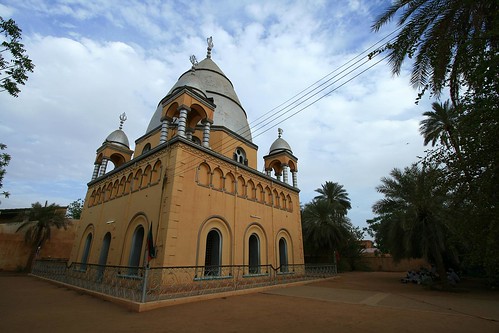
After a shower and a nap I was feeling much better and so decided to make an outing across the Nile bridge to Omdurman and visit the Mahdi’s tomb. My Bradt guide describes a friday evening at the tomb as “one of the highlights of any visit to Sudan,” but I was pretty underwhelmed by the experience. Described in the book is a lively scene of Sufi whirling dervishes who congregate each week to honor the Mahdi, but I found no dervishes and everyone I asked knew nothing about them. It was still worth a visit - the time and adjoining mosque are nice - but not too exciting.

I sat by the road to drink some tea afterwards and met Liam, the only other khawaja I’d seen so far in Sudan. He has lived in Khartoum for 2 years working for an NGO called Practical Action.

Traveling in many third-world countries has left me with a generally low opinion of most foreign aid efforts. All too often I see the ill effects of organizations who throw money at the symptoms of problems without addressing the real causes. There is no shortage of volunteers who seem to genuinely care and are devoted to their efforts, but there seems to be a real lack of good long-sighted guidance among these organizations, especially the ones I’ve encountered in Africa. So it was with skeptical ears that I listened to Liam describe the projects sponsored by Practical Action.

For once, I was genuinely impressed and very happy to learn about an organization that seems to be actually helping those in need on a permanent basis. For example: One of their projects addressed the famine in Darfur. The goal was to help the farmers regain the use of their land, most of which had fallen into disuse because they couldn’t afford the oxen needed to plow their fields. The engineers of the NGO worked with the local blacksmiths to invent a plow which can be operated with a donkey, a much more affordable alternative. The local blacksmiths build and sell the plows completely from local materials, the farmers are able to raise more crops, and the organization can remove itself from the equation and move on to other issues. Check out their website: http://www.itdg.org/.

Liam and I chatted for a couple hours over sheesha. He shared some stories about his travels around the Middle East and recommended some places for me to visit. We may cross paths again in Jordan in a couple months, insha Allah!

***

I’m beginning to get acclimatized to traveling in Sudan, and so far it’s been a great experience. Its amazing how far off the image i used to have of the country was from the reality. Of course, war and extreme poverty continue to affect many people in some provinces, but for millions of others, life is relatively good by east African standards and getting better. Khartoum has developed into a modern city to rival Dar es Salaam or Addis Ababa, thanks to the riches of the southern oil fields.

The civil war in the south appears, at least for now, to be over. I’ve met several Sudanis on the way to visit their families in the south for the first time in 10, 15 and even 20 years. And unlike certain other developing countries that have a strong security apparatus, Sudan has fully embraced the internet. The speed of the connections I’ve used in Khartoum are the fastest I’ve seen in Africa. The Sudanis I’ve met are well-informed about current events and are generally well-educated. I feel completely safe walking the streets ar any hour, and I’m never lost for than a few minutes before someone comes to my aid, often insisting that they personally show me to my destination.

If only it wasn’t so damn hot!

The Nile Route, Day 4


Sunday, April 20, 2008
Well Come.
1) Our objective is to give Full service for guests.
2) When you Enter to us there is payment for Registration.
3) If you Have full traveling Document you can move to any place of Sudan.
Have Agood Journey

I’ve just completed the immigration formalities at the border at Metema / Gallabat. The whole process cost me 3 passport photos and 2 photocopies of my passport, the unofficial currency on which Sudanese bureaucracy operates. After walking across the bridge into Sudan, I was sent to passport control to have my visa stamped and fill out a long form. The form required such critical data as blood type, parents names, religion and tribe (optional). It required one passport photo. After passport control, it was off to customs, where my bag was inspected and I was asked to explain some of the contents: a mean-looking game skinning knife from Kenya (for peeling fruit!), a bag of hundreds of unlabeled capsules (doxycyclene for malaria!), all those stamps in my passport (long vacation!). Then finally on to “security”. I fielded another barrage of questions, provided signatures, 2 more passport photos and another photocopy, and… I was done! I’ll be required to register again within 3 days at the Aliens Registration Office in Khartoum. I can’t wait.

Now, I’m sitting in a tea shack in Gallabat, waiting for the bus to Gedaref to fill up with passengers. I’m beginning to wonder if it ever will - 4 hours have passed and I’ve noticed hardly anything happening at all. Gallabat is certainly not a busy place.

First impressions:

  • Truck drivers of each region of Africa seem to have their own style of decorating their vehicles. Gallabat is full of big old blue Bedford trucks covered with colorful painted designs - eyes, slogans, faces - and big plumes of ostrich feathers in place of hood ornaments. Some of the wheels also have Ben Hur / Mad Max style steel spikes bolted on (most of the tuk-tuks also have these)!
  • Sudan seems to be considerably more expensive than the rest of east Africa. The 150km bus ride to Gedaref is costing me 10SD ($5.00) and a light meal of fuul and bread cost me 5SD ($2.50).
  • The currency: Sudan appears to be back on a new version of the Sudanese Pound - the 2nd currency switch-up in the last decade. This makes things a little confusing. 100 Dinars = 1,000 old Pounds = 1 new Pound. Prices are still variously quoted in any of the 3 currencies, so the answer to “how much?” can be easily misunderstood.

***

As it turned out, I was able to go all the way to Khartoum in one overnight 1,200km+ session. The ride to Gedaref was an easy 3 hours on sealed roads (recently completed by a Chinese company, this used to be a 10-hour journey). At the Gedaref station, a guy my age on his way home to southern Darfur came to my aid when he saw me having trouble with the taxi drivers. He helped me get a seat on a night bus to Khartoum and register (again) with the police in Gedaref.

Before the bus left, I sat down to chat over tea with an older Sudanese man. His English was excellent and he translated for some of his friends who joined us later. We talked about Saudi Arabia (”They aren’t real Muslims!”), Ethiopia (or Asubia as its called in Arabic) and American politics. His friend said, “I’ve never seen a khawaja [foreigner] with such a long mustache before, is it a tradition for you?” They were also very curious about my tooth and crown tattoo. I tried to tell them that it doesn’t mean anything but they simply couldn’t accept that answer.

The ride to Khartoum was reasonably comfortable. Before the sun went down I was able to see some small villages and long stretches of countryside as we rolled by. We drove past watering holes surrounded by herds of cattle, small complexes of mud-brick homes enclosed by fences made from flattened oil barrels, and caravans of camels carrying bundles of goods led by white-robed men.

I’m not usually able to sleep on the bus, but I never even got the chance to try this time because of the constant security checkpoints. At least once an hour we would pull over. Sometimes the stop would require no more than some questions and a passport check for the lone khawaja (me), but a few times I was marched off to a small office where I was questioned by a friendly soldier who wrote my details into a ledger. My backpack was lightly searched twice. Never before have I been subjected to this level of scrutiny in the name of security!

The Nile Route, Day 3


Sunday, April 20, 2008

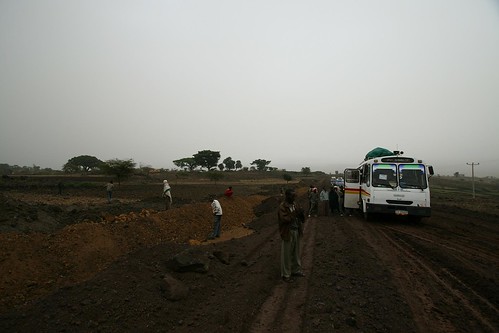
I arrived in Shihedi after a rough ride from Gonder that began at 4am. The last few days have brought the first rains of the season - normally dusty dirt roads have turned into muddy tracks. My backpack got thoroughly soaked on top of the bus thanks to a poor covering job by the weyero. It was slow going.

In just one afternoon I was able to see all that Shihedi had to offer. I passed the day chewing chat, drinking coffee, and chatting with locals. Most of that time was spent sitting in a dingy “chat den” conversing in broken English with a few strange characters.

The “den” was a small typical Ethiopian construction, with a dirt floor and mud-plastered walls. Balanced atop a pile of bricks in the corner sat a TV and DVD player, blasting out a continuous stream of Ethiopian pop music videos. The owner sat by the doorway, weighing out bags of chat on an old balance scale. A cooler stocked with Coca-cola and water sat opposite him across the room. A bench along each wall filled the remaining space. The walls were bare but for 3 large posters: Britney Spears (circa 2003, captioned “In the Zone”), Ronaldinho (”OK”), and Jennifer Lopez (striking a sexy pose, showing off her wedding ring).

I chewed nearly 100 grams of fer-fer (loose leaves) over a few hours - I was a bit high. The conversations, all translated by the one guy present who spoke some English, revealed a lot about the sad story of Shihedi.

Just an hour into Ethiopia from the border with Sudan, Shihedi is a small truck-stop town for drivers who ply the route between the two countries. Most of it is made up of cheap hotels, bars and brothels. It has a reputation for being quite a rowdy place - the horrible state of the economy has made catering to these truck drivers Shihedi’s main business. Tragically this has also earned it the #1 spot on the list of Ethiopian cities worst-affected by HIV/AIDS.

“Ethiopia is sick! We are dying,” one man told me with tears in his eyes.

I asked how often faranjis pass through Shihedi.

“Oh, quite often,” I was told. “Almost 1 every 2 weeks.” Often indeed!

Any many Americans?

“Not so many. Maybe some in a year. 10, 15.”

Thus began my departure from the beaten track. Walking around town made me feel like quite a celebrity. I could hardly go a few meters without giving handshakes to a dozen children. “You!” is the one English word that every Ethiopian child seems to know (the Amharic/Tigrinya equivalent, ante/at’ta, is the casual way to get someone’s attention and isn’t at all rude) and I heard it everywhere. I got used to the “faranji-frenzy” effect throughout Ethiopia, but here I was amazed at the level of excitement caused just by walking down the road. I slept poorly (too much chat) and left Shihedi on the first bus the next day at 8am.